
Commentaries are an important part of ARMA, and we’ve reinvented the commentary to make it effective in this milieu. As a result, instructors tell us that they value ARMA’s commentaries for the solid information they contain. It’s good to know of their appeal and, more importantly, to explore what makes ARMA’s commentaries meaningful to instructors and their students.
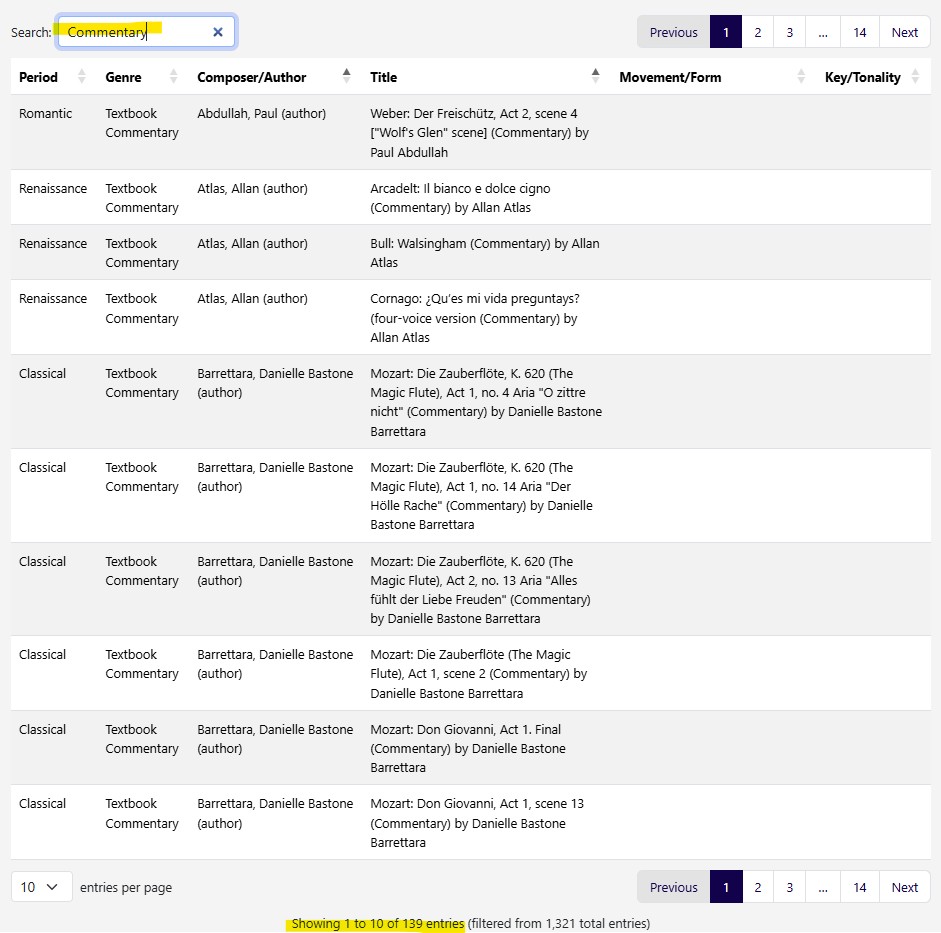
To become more familiar with ARMA’s commentaries, use your login to find them. A quick search for commentary will result in a list of all the commentaries currently available in ARMA.
Open a commentary to see how it looks. Notice the “header” information at the top of the commentary that contains details about the work under discussion, starting with a link to the score in ARMA.
The header items are self-explanatory, but also note the links to WorldCat, Naxos, and YouTube to find recordings of the work that you can use with your students in your courses.
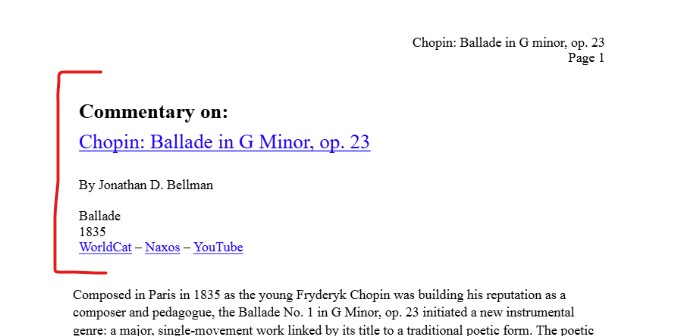
The “header” display is consistent between the commentaries, with the name of the piece consisting of the composer’s name following by the title and linked to the score. The genre of the piece is under the name of the author of the commentary, with the year of composition below it. The last header line contains links for recordings, specifically intems in (1) WorldCat (usually CDs); (2) Naxos (usually streamed items available through Naxos Classical Library, but sometimes CDs from Naxos); and (3) YouTube (often videos of performances). For the last item, students might enjoy the live performances available in
The body of the commentary begins after the header information, and it is a short essay, on average four pages and approximately 1600 words in length. Footnotes and references are optional, with the focus is on the music and how it works
To reach that focus, the commentaries have a four-part structure:
- Identify the work (100 words)
- Describe its context (250 words)
- Discuss the structure and other features of the work (1000 words)
- Explain the significance of the work, especially its relevance for modern audiences (250 words)
The word counts in parentheses give a sense of the proportions we advocate when working with contributors. Like other averages, they are goals for authors to use as their write effective commentaries and not hard-and-fast limits. After all, a virtue of a digital publication is the ability to surpass the limitations of the print environment. That aside, the emphasis in the commentaries is on the structure and features of the music. With that in place, it’s easy for authors to celebrate the significance of the works at the conclusion of each commentary.
A brief example of the organization follows.
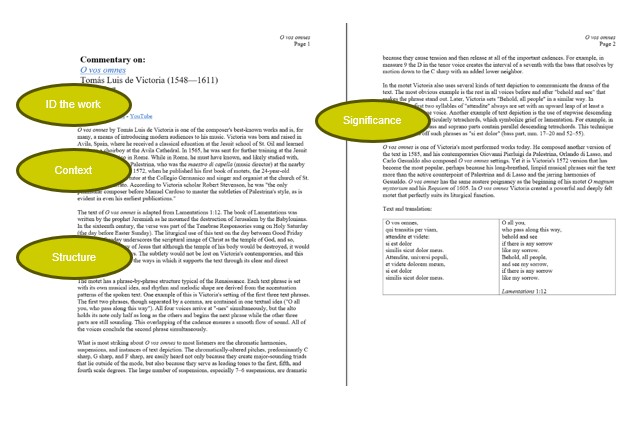
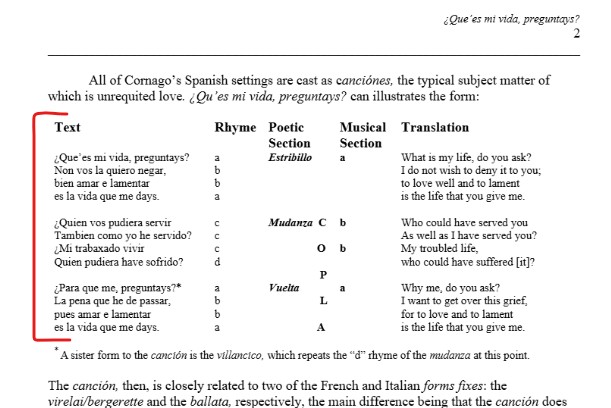
The example above shows graphically how the four-part structure works in a two-page commentary. Most commentaries are around four pages long, and have a similar structure. Because of the concision that’s part of ARMA’s style for commentaries, authors find ways to telegraph the content effectively. Beyond the concise writing style that is characteristic to this part of ARMA, authors rely on tables to outline structures or to show the interrelationship between elements in works. An example of the latter is in Allan Atlas’s commentary on ¿Qu’es mi vida preguntays? (four-voice version) by Cornago. By using a table Atlas shows the ways the poetic and musical structure align in a single image. It is an effective way to express the structure that contributes to the work’s significance.
Another approach is to use a table to bring together the various elements of a large work. A good example of this is Jonathan Shold’s tabular presentation that summarizes the individual movements of Robert Schumann’s Carnaval.
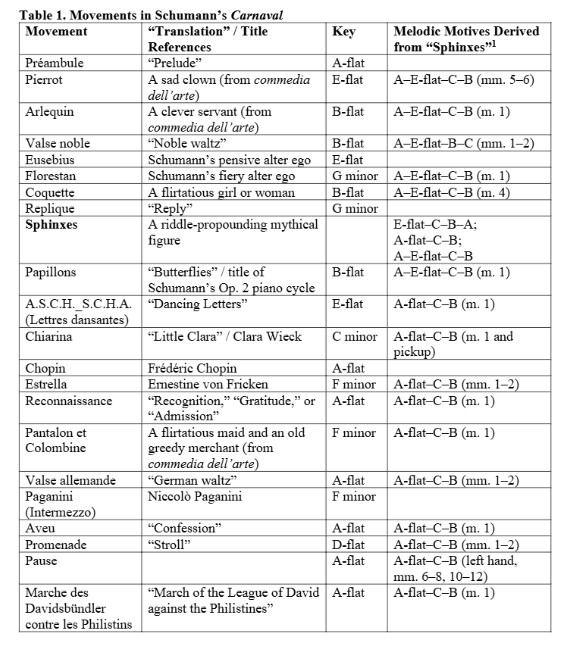
Here the table serves as a kind of Rosetta stone for exploring Schumann’s work, and instructors can use it as they prepare their own presentations on the significance of Carnaval and its influence on other composers and their audiences. In fact, it’s easy to return to the score by using the heading information, then click the title at the top of the commentary to open the score.
These are just two strategies author use to share their ideas the commentaries, and other commentaries include similar approaches to discussions of structure. Within the four–part structure in ARMA’s commentaries authors find their own ways to explore the music in in doing so share their insights on how the music works. Those perspectives are key to the commentary reinvented in ARMA, as it takes this element of print music anthologies to the digital enviroment effectively.
To find commentaries in ARMA, include the term commentary in your search criteria, along with the name of the composer and title of a piece. Searches can be broader when the criteria includes a genre, with the criteria “commentary madrigal” resulting in a list of all the commentaries for madrigals in ARMA. Please note that commentaries are available separately and also appended to the scores of the pieces, so that students always have these improtant discussions near the music they study.
